

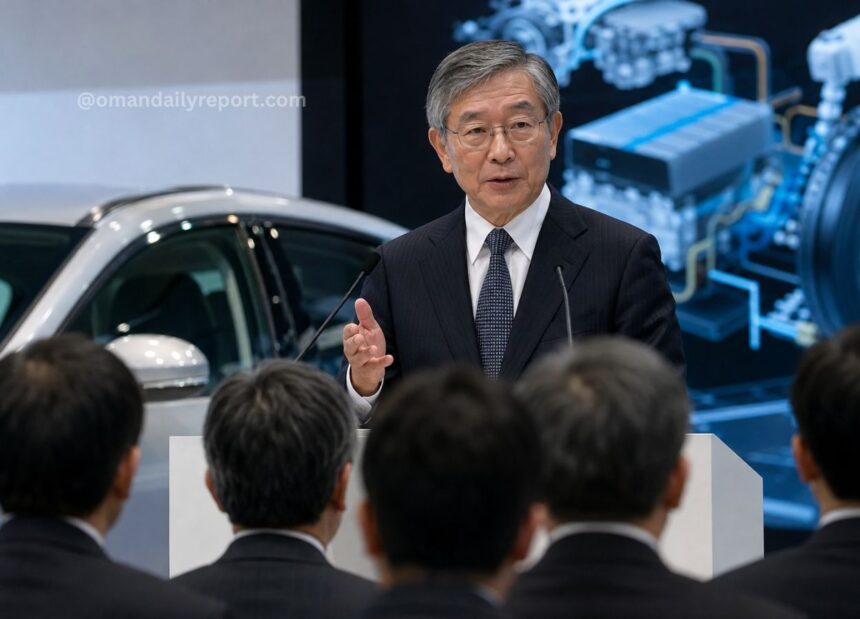
Hiroshi Okuda, the leader who guided Toyota Motor Corporation during a time of strong global growth and helped create the famous Prius hybrid, has passed away at the age of 93, the company said on Wednesday.
Taking charge in 1995 Okuda changed the way the company worked by becoming the chief executive chosen from outside the Toyoda family in almost thirty years. His time in charge was a change for the company, helping it move from being careful and cautious to being bold and strong around the world. This change helped Toyota become the car seller in the world beating General Motors.
When the economy had problems in the middle of the 1990s—like sales in Japan, a strong yen and less money from selling cars abroad—Okuda started the big plan called “Vision 2005” in 1996.
The blueprint emphasized constructing assembly operations directly within key global markets rather than relying exclusively on domestic exports. Within a decade of implementing these localization and cost-reduction measures, overseas sales more than doubled, driving overall global distribution up by 67 percent.

Simultaneously, Okuda reshaped sustainable transportation by accelerating the commercial release of the Prius. Introduced in 1997 a full year ahead of initial schedules, the car made history as the premier mass-produced gasoline-electric hybrid vehicle.
The bold engineering investment established Toyota as an industry benchmark in hybrid technology, a segment continuing to see robust global demand as consumer preferences balance between high electric vehicle prices and fuel expenses.
Born in 1932 in Mie prefecture to a family running a regional brokerage, Okuda joined Toyota’s accounting department in 1955. Early in his tenure, he earned a reputation as an uncompromising auditor by questioning senior managers over executive expenditures.
During his leadership of local operations in the Philippines in the early 1970s, his hands-on management style notably included trekking across jungle terrain to engage local insurgents. Beyond automotive manufacturing, Okuda exercised major influence across Japan’s commercial and economic policy spheres.
A skilled martial artist with a black belt in karate, he headed Japan’s influential business federation, Keidanren, from 2002 to 2006, served as an economic adviser to top government officials, and later directed the Japan Bank for International Cooperation in 2012. Okuda concluded his chairmanship at Toyota in 2006, leaving an indelible imprint on modern global manufacturing.