

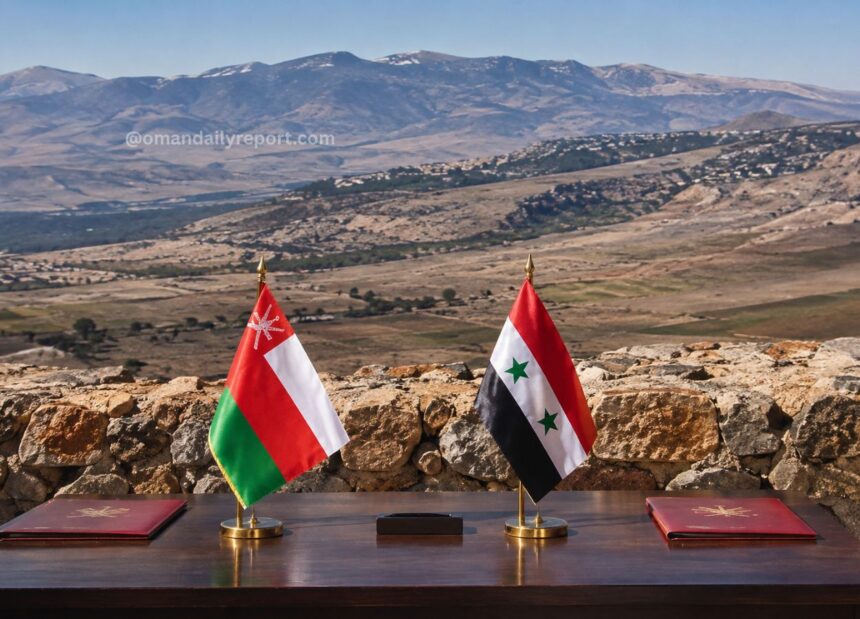
MUSCAT – Official statement issued by the Sultanate of Oman indicates that they do not agree to the acceptance of the Colombian government regarding Israeli sovereignty over the Golan Heights located in Syria.
This statement was released by the foreign ministry of Oman in a diplomatic note on Wednesday where they made it clear that “Golan Heights is an integral part of Syrian territory in accordance with international law.” Moreover, it was ensured that Oman “firmly supports the territorial integrity of Syria and urges all nations to comply with international laws and the Charter of the United Nations.”
It is important to note here that the Ministry of Foreign Affairs referred to United Nations Security Council Resolution No. 497 passed in 1981 that clearly stated that the decision by Israel applying its laws and administration over the occupied Syrian Golan was null, void, and had no legal effect.
Muscat made it clear that international stability lies in respecting international conventions and not diplomatic stance change.

The Foreign Ministry specifically highlighted United Nations Security Council Resolution 497, adopted in 1981, which explicitly determined that Israel’s decision to impose its laws, administration, and jurisdiction over the occupied Syrian Golan was null, void, and without international legal effect.
Muscat stressed that international stability relies upon universal respect for international conventions rather than unilateral diplomatic posture shifts.
The diplomatic backlash from Oman follows Bogota’s announcement on August 10, when Colombia became only the second sovereign nation globally to formally endorse Israeli territorial claims over the strategic plateau. The move places Colombia alongside the United States, which previously recognized Israeli sovereignty over the territory.
Oman’s firm diplomatic response reflects the Sultanate’s long-standing foreign policy strategy rooted in promoting peaceful resolution of regional disputes, upholding international law, and discouraging actions that unilaterally alter the legal status of occupied lands.
Omani officials cautioned that recognizing contested territorial claims outside the framework of international negotiations risks setting dangerous precedents in global governance and eroding the authority of international institutions.
By calling on global governments to respect international legitimacy, Muscat aims to reinforce the binding nature of UN Security Council decisions and preserve Middle Eastern regional stability.
The Omani Foreign Ministry reiterated that resolving complex regional conflicts requires an absolute commitment to established international parameters rather than political declarations that contradict globally recognized United Nations resolutions.