

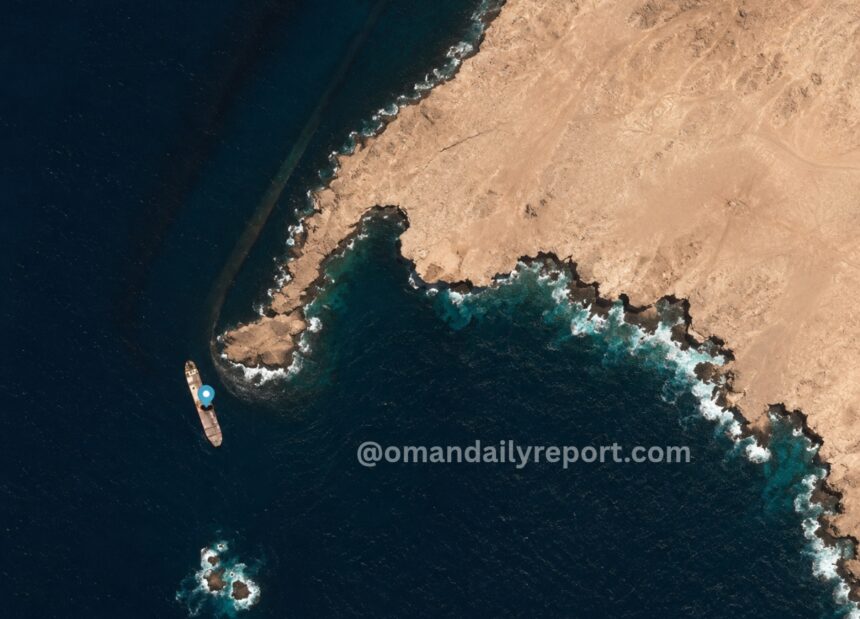
An oil slick from the grounded tanker Caroline Bezengi off Oman’s Al Hallaniyat Islands has expanded to about 390 square kilometres, prompting intensified monitoring as authorities work to contain the pollution and secure the vessel.
Oman’s Environment Authority said satellite imagery and technical assessments showed the contamination spreading northeast from the islands towards the mainland coast.
The slick has been detected along a track stretching roughly 449 kilometres, with its nearest point currently about seven kilometres from the shoreline.
Environmental modelling indicates the pollution could move another 121 kilometres over the next 48 hours, depending on wind, currents and sea conditions.
Authorities stressed that this projection is based on scientific modelling and may change as conditions develop. The 390-square-kilometre estimate refers to the area where oil pollution has been detected on the sea surface, rather than the quantity of oil released.
Officials said analysis suggests thicker concentrations could move towards the approaches to Ras Madrakah, increasing the need to monitor vulnerable marine and coastal areas.
Environment Authority Chairman Abdullah bin Ali Al Amri said current assessments had found no threat to key facilities along the coast, including desalination plants, aquaculture projects and economic and tourism sites.
Seawater testing is continuing as part of the response.Specialist teams from the Ministry of Transport, Communications and Information Technology are examining the tanker’s hull, identifying the sources of the leak and preparing to transfer its oil cargo safely.
Salvage operations are expected to follow.Weather conditions during Oman’s Khareef season have made diving and other work around the vessel more difficult.
At the same time, officials said prevailing conditions had helped move some of the oil away from Oman’s immediate shoreline. Authorities are using aircraft, satellite observations, marine surveys and environmental modelling to track the slick around the clock.
Protecting coral reefs, turtle nesting sites and other environmentally sensitive habitats remains a central priority. The incident has raised concern because the Hallaniyat Islands and surrounding waters contain important marine ecosystems.
The continuing monitoring effort is intended to assess the pollution’s movement and limit its potential impact on Oman’s coastline.